Executive Summary
In December 2025, NIST released its draft Cybersecurity Framework Profile for Artificial Intelligence (NISTIR 8596) — a landmark document that maps AI-specific cybersecurity considerations onto the well-established CSF 2.0 structure. For organisations already operating under ISO 27001, this creates both a strategic opportunity and an urgent challenge: your existing ISMS must now account for AI systems as security assets, AI-powered defence capabilities, and AI-driven threat vectors — all simultaneously.
This article explores how the NIST Cyber AI Profile intersects with ISO 27001 controls, what organisations need to do now, and how a shared control architecture approach can prevent the compliance duplication that cripples security teams.
The Regulatory Landscape Has Fundamentally Shifted
2026 is shaping up to be the year of regulatory convergence in cybersecurity. Organisations are facing a collision of compliance obligations: the EU AI Act high-risk system obligations are now in force, NIS2 enforcement is accelerating across EU member states, the UK Cyber Security & Resilience Bill is progressing through parliament, and now NIST has thrown its weight behind formalising AI cybersecurity governance through the Cyber AI Profile.
For ISO 27001 certified organisations, this isn't an abstract policy discussion. The Gartner top cybersecurity trends for 2026 identify agentic AI oversight and AI-driven SOC transformation as the defining challenges for security leaders. Meanwhile, the World Economic Forum's Global Cybersecurity Outlook 2026 reports that 87% of respondents identified AI-related vulnerabilities as the fastest-growing cyber risk over the past year. The share of organisations assessing AI tool security has nearly doubled — from 37% in 2025 to 64% in 2026.
The message is clear: if your ISMS doesn't address AI, your certification may be technically valid but operationally incomplete.
What Is the NIST Cyber AI Profile?
Released as NISTIR 8596 in December 2025, the Cyber AI Profile is a community profile built on the NIST Cybersecurity Framework (CSF) 2.0. It was developed in collaboration with the National Cybersecurity Center of Excellence (NCCoE) and the MITRE Corporation, with input from over 6,500 stakeholders.
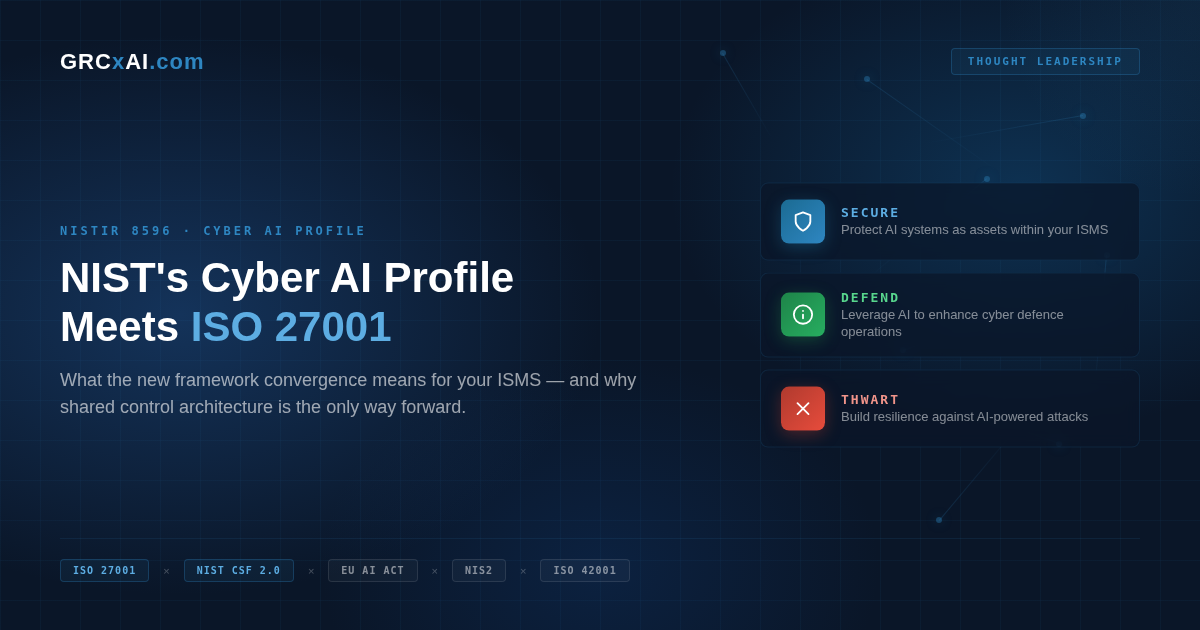
The profile organises AI cybersecurity considerations across three overlapping focus areas:
1. SECURE
Managing cybersecurity challenges when integrating AI into organisational ecosystems. This covers everything from securing AI model integrity and training data pipelines to protecting inference endpoints and AI agents.
2. DEFEND
Identifying opportunities to use AI for enhanced cybersecurity operations — threat detection, predictive maintenance, risk forecasting, and accelerated incident recovery.
3. THWART
Building resilience against AI-powered attacks — deepfake-based social engineering, automated vulnerability exploitation, adversarial model manipulation, and AI-coordinated swarm attacks.
These three focus areas are mapped against the six CSF 2.0 functions — Govern, Identify, Protect, Detect, Respond, and Recover — with AI-specific considerations, prioritisation levels (High, Moderate, Foundational), and informative references for each subcategory.
Where NIST Cyber AI Profile Meets ISO 27001
This is where it gets interesting — and where many organisations will struggle without the right approach. NIST's CSF 2.0 already has formal mappings to ISO 27001:2022 Annex A controls, published through NIST's Online Informative References (OLIR) program. The Cyber AI Profile extends these mappings with AI-specific considerations.
Here's how key ISO 27001 control areas intersect with the Cyber AI Profile's focus areas:
| ISO 27001 Annex A | NIST Cyber AI Profile | AI-Specific Consideration |
|---|---|---|
| A.5.9 Asset Inventory | ID.AM (Identify — Asset Mgmt) | Catalogue AI models, agents, training data as information assets; track model versions and lineage |
| A.5.23 Cloud Services | PR.DS (Protect — Data Security) | Assess AI-as-a-Service providers; secure AI workloads in cloud; data sovereignty for training data |
| A.8.8 Vulnerability Mgmt | DE.CM (Detect — Continuous Monitoring) | Monitor for adversarial attacks, model drift, prompt injection; AI-specific vulnerability scanning |
| A.5.24 Incident Response | RS.RP (Respond — Response Planning) | Include AI system compromise, model poisoning, and rogue agent scenarios in incident playbooks |
| A.5.2 InfoSec Roles | GV.RR (Govern — Roles & Responsibilities) | Define accountability for AI security: data scientists, ML engineers, AI governance leads |
| A.8.25 Secure Development | PR.DS (Protect — Data Security) | Secure ML pipelines, validate training data integrity, protect model weights and IP |
| A.5.19 Supplier Security | GV.SC (Govern — Supply Chain) | Evaluate third-party AI model providers, assess AI supply chain risks, monitor for compromised models |
The critical insight is that the NIST Cyber AI Profile doesn't replace ISO 27001 — it extends it. Organisations that already have a mature ISMS have a significant head start. But they need to systematically review each Annex A control through an AI lens and document the additional considerations.
The Control Duplication Problem
Here's the practical challenge: an organisation operating under ISO 27001, with obligations under NIS2 or the EU AI Act, and now looking to align with the NIST Cyber AI Profile, faces a massive control mapping exercise. Without a systematic approach, compliance teams end up maintaining separate evidence packs, separate risk registers, and separate audit trails for what are often the same underlying controls.
Consider a single requirement: maintaining an inventory of AI assets. This requirement appears across:
- ISO 27001 Annex A.5.9 — Inventory of information and other associated assets
- NIST CSF ID.AM — Asset Management (with AI-specific extensions in the Cyber AI Profile)
- EU AI Act Article 9 — Risk management system for high-risk AI systems
- NIS2 Article 21 — Cybersecurity risk-management measures
Four frameworks. One control. Four separate pieces of evidence — unless you have a shared control architecture that allows you to test once, satisfy many.
A Practical Roadmap: Integrating AI into Your ISMS
Based on the NIST Cyber AI Profile structure and ISO 27001 requirements, here are the critical steps organisations should take:
Step 1: Conduct an AI Asset Discovery
Before anything else, map every AI component in your environment: models, agents, algorithms, training datasets, inference endpoints, and third-party AI services. This becomes the foundation for both your ISO 27001 asset register and the NIST Cyber AI Profile's IDENTIFY function.
Step 2: Extend Your Risk Assessment Methodology
Your existing risk assessment process needs to incorporate AI-specific threat categories: data poisoning, model inversion, adversarial manipulation, prompt injection, and AI supply chain compromise. Map these against your existing risk register and treatment plans.
Step 3: Map Controls Across Frameworks
Create a cross-framework control mapping that links ISO 27001 Annex A controls to NIST CSF subcategories, Cyber AI Profile considerations, and any other applicable frameworks (EU AI Act, NIS2, ISO 42001). This eliminates duplication and creates a single source of truth for evidence collection.
Step 4: Implement AI-Specific Governance
Establish an AI Change Advisory Board or equivalent governance mechanism. Any time a model is deployed, retrained, or a new AI service is adopted, it should go through a structured review that addresses security, privacy, compliance, and ethical implications — aligned to both your ISMS and the NIST GOVERN function.
Step 5: Build Continuous Assurance
Move beyond point-in-time assessments. The NIST Cyber AI Profile emphasises continuous monitoring, and so does modern ISO 27001 practice. Implement real-time monitoring of AI system behaviour, automated compliance evidence collection, and regular AI impact reviews within your management review cycle.
What's at Stake: The Market Reality
The global AI in cybersecurity market is projected to reach approximately $35 billion in 2026, growing at nearly 19% annually. Global cybersecurity spending overall is projected to reach $240 billion in 2026, with AI-driven security spending growing three to four times faster than the broader market.
Gartner forecasts that 40% of enterprise applications will feature task-specific AI agents by 2026, yet only 6% of organisations have an advanced AI security strategy in place. This gap represents both a risk and a competitive opportunity. Organisations that can demonstrate AI security governance — through ISO 27001, NIST alignment, and cross-framework compliance — will have a significant advantage in procurement, partnerships, and investor confidence.
The first major lawsuits holding executives personally liable for the actions of rogue AI agents are anticipated in 2026. AI security is moving from discretionary to board-level governance — fast.
How GRCxAI Addresses This Challenge
GRCxAI.com is built specifically for this convergence challenge. The platform provides pre-built control mappings across 26 international standards and ESG frameworks — including ISO 27001, NIST CSF, EU AI Act, NIS2, and ISO 42001 — enabling organisations to implement a shared control architecture that eliminates compliance duplication.
With 500 document templates, 1,800 assessment questions, and 1,700 training modules, GRCxAI operationalises the cross-framework compliance that the NIST Cyber AI Profile demands. Instead of managing separate evidence packs for each framework, organisations can test once and satisfy multiple regulatory requirements simultaneously.
The Bottom Line
The release of NIST's Cyber AI Profile is a signal that AI cybersecurity governance has moved from aspirational to structural. For ISO 27001 certified organisations, the question is no longer whether to integrate AI into your ISMS, but how quickly you can do it without drowning in duplicate compliance work.
The organisations that will thrive are those that adopt a shared control architecture — mapping once, testing once, and satisfying ISO 27001, NIST CSF, EU AI Act, NIS2, and ISO 42001 through a single, operationalised framework. The regulatory storm is here. The question is whether you're building a shelter, or building a ship.
Want to see how GRCxAI maps the NIST Cyber AI Profile to your existing ISO 27001 controls?
Book a 15-Minute Walkthrough